

From my experience thus far, for most of the people on the campus, the word “development” immediately translates into websites and apps. However, for people who dare to venture beyond the average and actually look past the horizons of grabbing fat packages and competitive programming, there lies a universe that only a handful dare to (or maybe care to?) explore - game development.
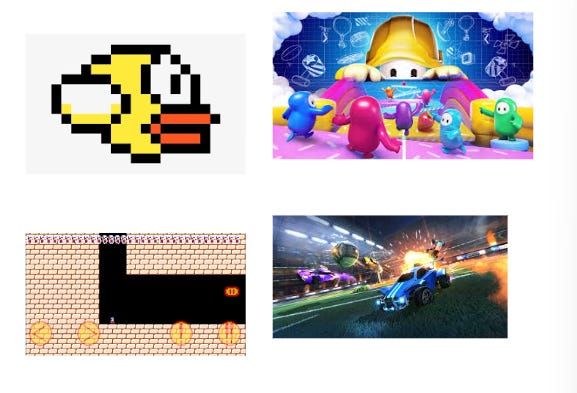
Coming back to the topic, game development isn’t just about fun; it’s a field where creativity meets code and transforms lines of logic into living, breathing worlds. From billion-dollar franchises to deceptively simple sensations or the notoriously rage-inducing, games have proven that both scale and simplicity can be wildly rewarding.
In this article, my aim is to take a deep plunge into this new (🤨) field with you. We’ll explore how game development is a beautiful concoction of almost all other fields of computer science you might be already aware of. We’ll see how one can start exploring this field, how rewarding it can be and also why possibly your definition of “rewards” has been wrong all this time. I’ll try to explain everything in a lucid, fun and engaging manner. With all this, hoping we’re all equally excited, let’s begin!!
Case Study : Flappy Bird – The simpler the better?
In 2013, a little-known Vietnamese developer named Dong Nguyen created a simple mobile game called Flappy Bird. Built in just a few days, the game featured a pixelated bird navigating through Mario-like pipes - hardly a graphical masterpiece. For months, it went unnoticed.
But then something unexpected happened: Flappy Bird went viral, climbing app store charts worldwide. At its peak, it was generating over $50,000 per day in ad revenue. The simplicity, frustration, and addictive design turned it into a cultural sensation.
From an unknown indie coder to a name recognized across the gaming industry, Nguyen’s story proved that you don’t need a AAA budget to strike gold. Sometimes, all it takes is a clever idea, solid execution, and a touch of luck.
Case Study: Supercell – From Struggles to Mobile Gaming Giants
In 2010, a small Helsinki-based start-up named Supercell set out to make games. The early days weren’t easy - their first few projects failed, and the company was close to shutting down. Instead of giving up, they embraced a bold philosophy: “the best teams make the best games.”
Supercell gave its small, independent teams full creative freedom. That freedom led to the release of Clash of Clans in 2012 - a mobile strategy game that redefined what mobile gaming could be. It quickly became a global phenomenon, earning millions daily and cementing Supercell’s reputation.
They didn’t stop there. Titles like Clash Royale, Boom Beach, and Brawl Stars followed, each capturing massive audiences worldwide. By 2016, just six years after its founding, Supercell was valued at $10.2 billion, making it one of the most successful gaming companies ever - all from a country with fewer people than New York City.
So what can we conclude from these case studies?
A well-timed idea, coupled with the right execution, can captivate millions of players worldwide — and sometimes even become a cultural phenomenon. Beyond the entertainment, the industry itself is booming, offering lucrative opportunities for developers who are willing to dive in and innovate.
Now that we have a bit of background, let’s say we want to start making games. Now what? How do we do it? What do we need to get started?
The answer is
Game Engines : The powerhouses behind every game
A game engine is the core software framework that powers a video game. It provides ready-made systems for graphics rendering, physics, audio, input handling, AI, and scripting, so developers don’t have to reinvent the wheel every time they make a game.
Without game engines, building even a simple game would require writing thousands of lines of low-level code just to display characters, detect collisions, or play sounds. Engines save time, streamline workflows, and allow developers to focus on creativity, storytelling, and gameplay rather than technical grunt work. The three most popular gaming engines in the world are Unity, Unreal and Godot - all of these are described below.
Unity
Unity is one of the most versatile and widely used game engines in the world. It supports both 2D and 3D development and is especially popular among indie developers and mobile game creators. With its massive asset store, developers can buy or download ready-made models, scripts, and tools to speed up development.
Strengths:
Cross-platform deployment (PC, mobile, console, VR, AR).
Beginner-friendly with a large community and tutorials.
Huge library of assets and plugins.
Notable Games: Among Us, Monument Valley, Pokemon Go, Subnautica.
Best For: Beginners, mobile/indie developers, and rapid prototyping.
Unreal Engine
Developed by Epic Games, Unreal Engine is known for its photorealistic graphics and is a staple in the AAA gaming industry. It’s used to build high-end PC, console, and VR games, but it’s also flexible enough for indie developers. Its signature tool, Blueprints, allows for visual scripting, making it easier for non-programmers to create complex mechanics.
Strengths:
Industry-leading graphics and rendering.
Visual scripting (Blueprints) + powerful C++ backend.
Free to use with a royalty model (Epic takes a small share after success).
Notable Games: Fortnite, Valorant, Street Fighter.
Best For: High-end 3D games, cinematic experiences, and VR/AR projects.
Godot
Godot is an open-source game engine that has been rapidly growing in popularity. Unlike Unity or Unreal, it doesn’t have a corporate owner, meaning it’s completely free with no licensing fees or royalties. It’s especially loved by indie developers for 2D games, but it also supports 3D (with improvements coming rapidly). Godot uses its own scripting language called GDScript (similar to Python), but also supports C# and C++.
Strengths:
Lightweight, flexible, and completely free.
Excellent for 2D development.
Active and passionate open-source community.
Notable Games: Deponia (port), Kingdoms of the Dump (in dev), many indie titles.
Best For: Indie devs, students, experimental projects, and those who prefer open-source tools.
In short: Unity is the jack-of-all-trades, Unreal is the AAA powerhouse, and Godot is the rising open-source hero of game engines.
Unity is the standard engine that works well on most devices, whereas Unreal will cause difficulties on low spec PCs. Godot isn’t as popular as the other two options yet and features less intensive resources. Consider these points before selecting your game engine.
Now that we’ve selected a game engine, it’s time to program our game. Thankfully, these game engines make the job quite easy for us and the programming involved is not as hard as one would assume. The programming is largely object-oriented (oops 🥲) and the various libraries and in built functions provided by the game engine specific libraries leave our work down to merely selecting the correct assets, controlling and selecting appropriate game audio, controlling object physics, handling multi-player functionalities, etc. All of this makes developing a simple game fairly easy in a game engine. Another mistake many people make is that they try to learn all the nooks and crannies of the development framework before getting into actual projects. However, a more encouraged approach is to dive right into projects and learn while building. In my experience, this enhances both retention and problem solving skills.
So at this point, go ahead!
Select a simple idea, choose a game engine, fiddle around with some code and come up with a game of your own!
You may also publish it and even monetize it on free-to-use platforms like itch.io, Kongregate, Newground, etc. We would love to see your creations! Share relevant links here (https://forms.gle/YatUbCepKb6pfHjF7) and we’ll go through all of them! (Well the Inter IIT Tech Meet promises a game dev PS every year … soooo 😉)
Make sure you make a submission, preferably by month end. Even a simple one (in fact the simpler the better :) ) would make our efforts worthwhile. You are of course free to use any of the AI tools you use everyday - speaking of which….
Artificial Intelligence, Machine Learning and … Game Development ?
Imagine playing a game where the enemies don’t just follow pre-coded patterns, but actually learn from your every move. You dodge their attacks once, they try something new the next time. This is the promise of Machine Learning (ML) in game development — a shift from predictable scripts to adaptive, intelligent systems.
ML is already sneaking into many corners of game design. Non-playable characters (NPCs) can become smarter, learning strategies instead of mindlessly repeating routines. Worlds can be built dynamically through procedural content generation, meaning every player gets a unique adventure. Games can even adjust their difficulty in real time, predicting when a player is getting bored or frustrated and tweaking the experience to keep them engaged.
It doesn’t stop at gameplay. Machine learning also fuels voice synthesis, motion capture, and lip-syncing, making characters feel more alive. Behind the scenes, ML agents can even playtest games thousands of times faster than humans, spotting bugs or balance issues before release.
From survival horror titles like Alien: Isolation (with its cunning, unpredictable alien) to expansive universes like No Man’s Sky (built on procedural generation), we’ve already seen glimpses of this future. And as ML grows, games will no longer just be hard - coded experiences - they’ll be living, evolving worlds that will learn and react to us, glimpses of which we can already see in various places.
Okay, all of this seems pretty fun. But what do I get out of this?
With the rapid increase in demand for unique indie experiences, the exponential growth of the gaming and entertainment sector, and the relatively low competition in the current market, game development may turn out to be a very rewarding field for aspiring software developers. Conventional game development hackathons, internships and placement opportunities also feature much lower competition compared to standard SDE roles.
Also, yearning for just monetary benefits by jumping into more conventional sectors might seem tempting, but in my humble opinion, a real engineer is not a web developer. Not a data analyst. Not a game developer for that matter. A real engineer is a problem solver, and the sooner you develop the “Give me any problem and I’ll solve it somehow” attitude by venturing into and exploring diverse fields, the richer the long term rewards are.
Beyond just career prospects, game development is a space where logic meets imagination — where the skills you’ve built in coding can breathe life into entire worlds. Whether it’s a simple mobile hit, an indie masterpiece or an immersive universe, every game starts with the same spark: an idea. And with today’s tools, that spark can come from anyone — even you.
So maybe the next time you think about building yet another portfolio website, ask yourself: why not build the next game the world can’t stop playing?
Some interesting resources :
As far as learning is considered, a good mix of documentation, courses and fiddling around is recommended. However, for developing interest, I’d suggest the following channels on YouTube.
1. Code Bullet (@CodeBullet)
2. Dani (@danidev)
3. Game Dev Experiments (@GameDevExperiments)
4. Thomas Brush (@thomasbrush)
Documentation :
Unity official documentation : https://docs.unity.com/en-us
Unreal official documentation : https://dev.epicgames.com/documentation/en-us/unreal-engine/unreal-engine-5-6-documentation
Godot official documentation : https://docs.godotengine.org/en/stable/
 | A guest post by
|
Great case studies and learnings -- thanks for sharing!